5 min read
Mexico's deadline for electronic time tracking ends December 31
Since May 1, 2026, Mexico's Federal Labor Law requires companies to record every employee's working hours electronically, and the adjustment period ends on December 31. This article covers the obligation, the fine for not meeting it and the steps to be compliant by January 1, 2027.
By Alejandro Hatchett — Chief AI Architect
When an employee sues over unpaid overtime, Mexico's Federal Labor Law (LFT) places on the company the burden of proving both regular and overtime hours (art. 784, sec. VIII). A company that only has paper attendance sheets, a time clock that was unplugged for three months and a spreadsheet anyone could edit cannot prove them.
Since May 1, 2026, the Law also requires companies to keep that record electronically, and failing to keep it carries a fine.
The obligation is already in the Law
The reform published on May 1, 2026 added a new obligation to article 132: your company must record each employee's working hours electronically, with start and end times, and hand that record over to the authorities when they require it.
The reform set May 1 through December 31, 2026 as the period to adjust work processes. On January 1, 2027, the general provisions of the Ministry of Labor (STPS) take effect; they define which companies the obligation applies to and its exceptions.
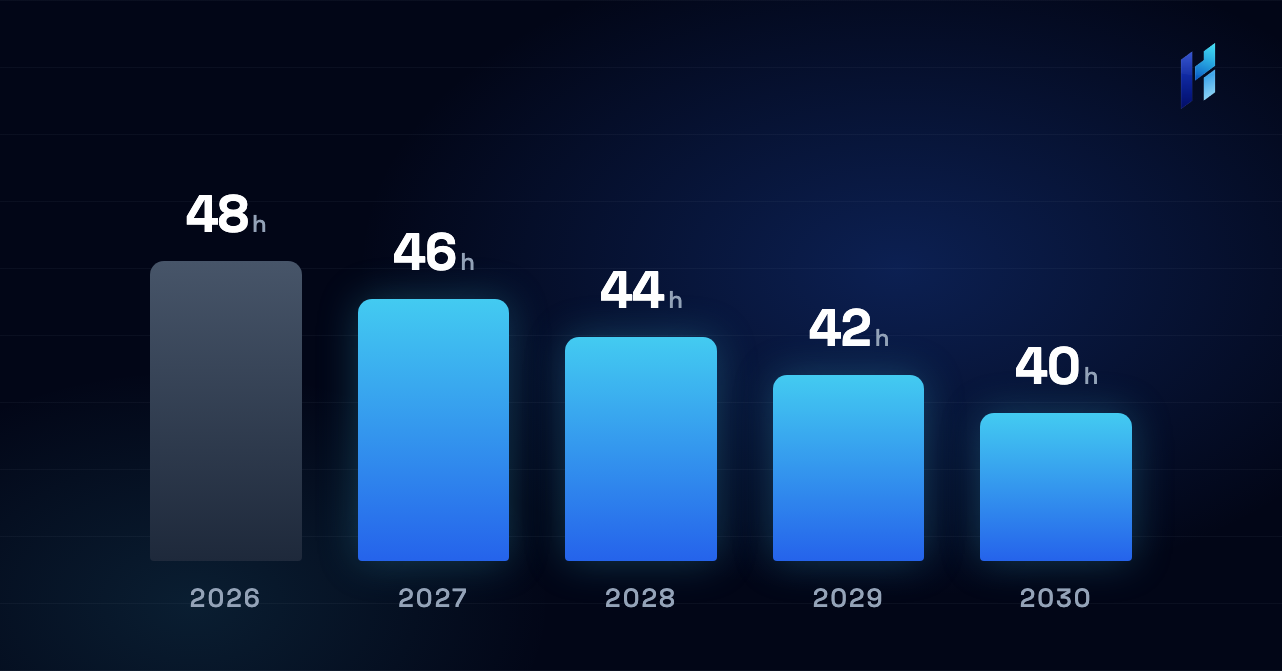
At the same time, the maximum workweek drops by two hours each year, starting every January 1:
- 2026: 48 hours
- 2027: 46 hours
- 2028: 44 hours
- 2029: 42 hours
- 2030: 40 hours
Every hour above that limit is overtime. In 2027, up to 9 overtime hours a week are paid at double the regular rate, and any hours beyond that, at triple. A 48-hour shift, legal today, generates two overtime hours a week in 2027.
The fine applies to each employee
The fine for not keeping the record ranges from 250 to 5,000 UMA, Mexico's unit for fines and fees (LFT, art. 994, sec. IV Bis). Article 992 adds that when a single omission affects several employees, the fine is imposed for each affected employee. In a company with one hundred employees and no record, the minimum fine is multiplied by one hundred.
In a lawsuit, the electronic record counts as full proof if the employee and the company agreed to it (art. 132, sec. XXXIV).
The record also documents how many hours each person worked, and those hours can be compared against the stamped payroll receipts (CFDI). If the record shows someone worked 50 hours and payroll paid no overtime, the comparison shows the difference.
Paper doesn't meet the electronic requirement, and time clocks can be altered
Paper sheets, time clocks and spreadsheets share the same flaw: they can be changed without leaving a trace. The company cannot show that no one altered them, and the employee has no way to verify what they recorded.
Fingerprint and facial recognition clocks solve identification, but they store each employee's fingerprint or face, information the company is responsible for protecting.
Six criteria for choosing a time tracking system
These are the criteria I use to evaluate any time tracking system, ours included:
- It works wherever your staff works. At the branch, from home, in the field and even for employees without a phone. A system that needs a device at the entrance leaves field staff out.
- The evidence cannot be altered. Each record keeps its date, time and place, and each correction keeps its reason, who made it and the employee's acceptance, without erasing the original record.
- The employee accepts it. The Law gives full evidentiary value to a record the employee and the company agreed to.
- It calculates overtime with each year's limit. The limit changes in 2027, 2028, 2029 and 2030. A system with the limit fixed at 48 hours miscalculates from the first day of 2027.
- It reconciles with payroll. Differences between recorded and paid hours show up in your report before anyone else finds them.
- It respects your employees' privacy. No biometrics, and location only at the moment of recording, never in real time.
Four steps before January 1
Fewer than eight weeks remain, and the work goes in this order:
- Inventory. How many branches and employees there are, who works outside the office and which shifts are in place.
- Schedules against the 46 hours of 2027. The shifts above the limit are identified, and the company decides whether to adjust them or pay those hours as overtime.
- Current overtime pay. If the stamped payroll does not reflect the hours actually worked, it is corrected before the record starts.
- Choosing the system and each employee's acceptance. Each employee's acceptance is collected within the same deadline.
Our time tracking system at ServiTecHub
At ServiTecHub we built an electronic time tracking system around these six criteria. It requires no time clocks, fingerprint readers or equipment at the branch; it stores the evidence so it cannot be altered; it calculates overtime with each year's limit, and it reconciles the record with the stamped payroll.
The full presentation is at servitechub.com/en/products/electronic-time-tracking/. In a diagnostic session we review your branches, schedules and headcount, and show you how to be compliant by January 1.
I'd like to hear how your company is getting ready. Let's continue the conversation on LinkedIn.
Anything to add or push back on? The conversation continues on LinkedIn.